Legal Translation Services

We Translate Legal Documents
Companies are becoming increasingly global. This presents new challenges, such as having to translate contracts, agreements, and other important legal documents across multiple languages.
When that happens, which language should you use? How can you ensure that these documents are legally valid in both the origin and destination countries? Being able to answer those questions is a critical part of succeeding in the modern business environment.
Each country’s legal authorities – whether courts, registry offices, ministries, or executive agencies – operate under their own laws, rules, and procedures. Ignoring them can lead to serious issues for a business trying to establish itself, create a partnership, or resolve a problem. And this “right or wrong” standard is one of the main concerns when it comes to legal translation services.
The Federal Rule of Evidence No. 604 says that translators must be qualified and take an oath promising to do a true translation. A party that does not follow this rule could face sanctions from the court. Similar rules exist at the state level. Our team is capable of following all of the requirements for your case based on advice from your counsel so that you don’t have to worry about it.
Keep reading to learn more about our legal translation services and how they can help your company thrive.
How To Get Started
Free Quote
sales@thetranslationcompany.com
800.725.6498
#1 Contact us to get a free quote or questions answered, or
#2 Upload your files for an instant translation quote, or
#3 Schedule a free Zoom meeting with our team now.
Cross-border activities requiring Legal Translation Services
Many companies that need legal document translation services need help with the following things:
- Starting a business
- Creating partnerships between companies
- Contracts of sale and purchase of products and services
- Relocating employees across borders
- Immigration documents
- Starting or responding to lawsuits filed in foreign courts
- Translating evidence collected for cases
- International business deals
- Localization services
- Applying for licenses in other countries
At the Translation Company, we’ve been translating legal documents like these for years and offer highly accurate legal translation services that will help your business accomplish its goals.
Free Quote
sales@thetranslationcompany.com
1.800.725.6498
Receive a quote today!

Certified Translation Services with a
100% Satisfaction Guarantee!
Legal Document Translation Examples
As you look more closely at your certified legal document translation needs, it can be helpful to see some sample translation solutions. Here’s a look at what a professional translator may be able to replicate for your company.
Scenario 1
A U.S. law firm defending an aircraft manufacturer against wrongful death claims: related to an aircraft crashing outside the U.S. Both US and non-US citizens hired a U.S. law firm to represent their claims. Depending on the crash site, different languages are used in witness statements, accident investigations, medical documents, etc. Many of these documents would need English translations from a certified legal translator meeting the court standards.
Scenario 2
A contract for business in a foreign country needs to be translated into that country’s language. A party to the contract who does not speak the language would need a certified translation to understand its content. Additionally, a foreign country may require a contract to be written in a certain language to be enforceable.
Scenario 3
A startup company opening a branch in Mexico need to translate its by-laws into Spanish so local attorneys could submit the translated version to the registration authorities. Other documents such as tax documents and contracts between the US HQ and local parties, and personal documents for the US management team relocating to Mexico, may require translation services.
Risks of Using Cheap Legal Translations
Your venture’s success overseas will require legal documents with quality translations from a professional service that can deliver them accurately and in compliance with all laws in the country where they will be used. Even small mistakes can create ambiguity and call into question the credibility of your organization.
Similarly, court proceedings often come down to the facts. If your translation process or the translation agency that you use isn’t up to par, then it could have an impact on legal matters that impact the success of your company.
Expert-level translation skills take years, if not decades, to develop. That is why quality foreign language translations will never be possible at the lowest bid level.
The potential consequences of using cheap and low-quality legal translation services include:
- The opposing party challenges your translated document and the judge orders you to get a better translation.
- Court or agency penalties and fines.
- Increased costs for attorneys and other professionals due to rework.
- Delays in processing, which could result in lost opportunities.
- Loss of confidence in your professionalism by partners, courts, and agencies.
- Interpretation of contract wording in your disfavor when you provided the faulty translation.
How To Get Started
Free Quote
sales@thetranslationcompany.com
800.725.6498
#1 Contact us to get a free quote or questions answered, or
#2 Upload your files for an instant translation quote, or
#3 Schedule a free Zoom meeting with our team now.
Accurate Legal Translations: Credentials and QA.
Need quality legal translations into foreign languages? Our certified legal translators can help. Their experience, standards, and credentials highlight how valuable our legal translation services can be to your organization. Here’s what we offer:
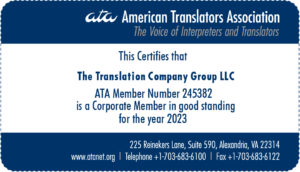
- Accreditation by the American Translation Association.
- Translators are certified by relevant associations and universities.
- Native speakers of the target language with extensive linguistic training and experience.
- Attention to the terminology of the source and target languages.
- Concept adaptations for translations involving both Civil Law and Common Law systems.
Project Management From Start to Finish
Our project managers will also supervise your project from start to finish. This ensures that you get the most accurate translation possible every time. And when you have more accurate translations from your legal language translator, you can look forward to better results.
Project managers will ensure that all relevant legal terminology is followed for as long as you retain our legal translation services. It’s one of the main reasons why our certified legal translation services stand out from the competition.
Quality Control
When you hire us for certified translations of legal terminology, you also get an in-depth quality control process that ensures every legal document we review is handled correctly.
Our Process
Our legal translation quality control process includes the following steps:
- Translated documents are reviewed and approved by a second person to promote exceptional quality.
- Certified translations include a statement of accuracy and faithfulness to the original document to give law firms confidence.
- Quality control by the translator and TTC as per ISO 9001 and ISO 17100 standards
- We guarantee acceptance of our legal translations in US courts and government departments
Free Quote
sales@thetranslationcompany.com
1.800.725.6498
Receive a quote today!
Some of the Law specialties that We Cover
Legal departments across the country trust us because we have legal expertise in many major areas of practice. For example, when you hire us to translate your legal materials, you can look forward to quality translation of documents from each of the following areas of law:
- Banking Law
- Case Law
- Civil Law
- Commercial Law
- Contract Law
- Copyrights Law
- Criminal Law
- Family Law
- Intellectual Property
- Litigation
- Protocols & patents
- Sales & Acquisition
The bottom line is that we can help with the legal translation of a legal document from just about any specialty you may need.
For a Wide Variety of Legal Documents
No matter what kind of legal document (or legal documents) you have, we’re a legal translation company that you can count on for help. Examples of certified legal translation services provided by our company on a daily basis include:
- Real estate files
- Corporation / LLCs
- Licenses & Permits
- Insurance Policies
- Contracts
- Certificates & Affidavits
- Judicial Orders
- Sales Contracts
- Foreign Applications
- Disclosure Agreement
- Business Forms
- Trademarks & Copyrights
- Agreements
- Legal reports
- Birth Certificates
If you’ve got a legal document, there’s a great chance that our legal translation company can help you get it into your desired language.
Additional Services for Legal Translations
Ideally, your attorney or in-house counsel will tell you the exact legal requirements for our legal translation service. But that doesn’t always happen.
As a free service, our staff can provide some recommendations on additional legal document translation options. For example, our legal translators may suggest each of the following legal document translation services.
Certified Legal Translations
For documents to be used in court, we can certify that our translation is faithful to the original and prepared by professional translators under a professional translation company’s supervision.
If subpoenaed, our company may appear in court to provide a sworn attestation of the certification (costs covered by the Client).
Notarization
A notarization of our Certified Translations adds another element of trust. Notarization is also required for an apostille, which is in turn required for translated documents to be accepted by courts in some countries.
County Clerk
County clerks verify the signatures of notary publics who signed our certification statements. The country clerk will sign along with the notary public’s signature and attach their seal to the document.
Apostille
Apostille is a protocol needed for a document to be considered nationalized in the target country. In the US, the State Department issues apostilles for translated documents that have been certified and notarized. Learn more about apostilles here.
Rush Translations Available
Sometimes, you have a legal translation need that just can’t wait. If you’ve got important legal documents to translate with an impending deadline, we can help.
We offer rushed legal translation services on-demand. We may not always be able to meet your legal translation timeline but we’ll always do our best to get your legal documents back to you as soon as we possibly can.
We can also handle specific requirements unique to your legal translation project. Contact us now to learn more about our legal document translation services.
Legal Translation Company
Our client base includes all entities involved in legal proceedings from the world’s leading law firms to government agencies, courts of law, and corporations across the planet.
This ensures that we have the legal translation experience to help you meet your goals no matter what legal documents you need us to work with.
So why not take advantage of the value our legal translators can provide? Get a free quote today to learn more about how we can help.
Free Quote
sales@thetranslationcompany.com
1.800.725.6498
Receive a quote today!
Certified Translation Services with a
100% Satisfaction Guarantee!
Join hundreds of satisfied clients who continue using our legal translation services, including Law Firms, Government Departments, Courts, and Corporations in the US, Canada, and Europe.
Whether you need a legal Spanish translation or any of our 200+ languages, we guarantee the acceptance of our translated documents in any US court.
How To Get Started
Free Quote
sales@thetranslationcompany.com
800.725.6498
#1 Contact us to get a free quote or questions answered, or
#2 Upload your files for an instant translation quote, or
#3 Schedule a free Zoom meeting with our team now.